
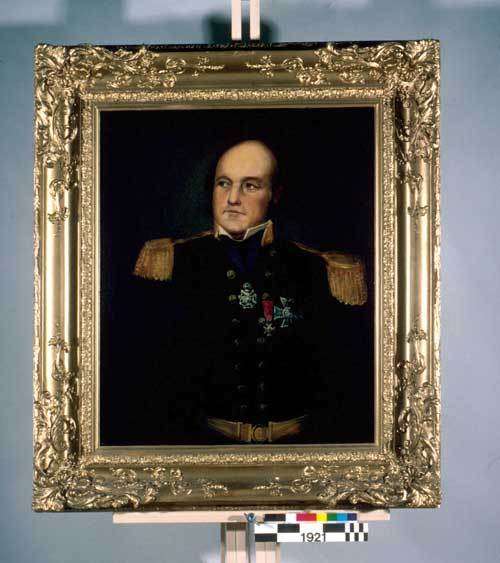
Framed portrait of Sir John Franklin prior to my restoration treatment
The frame came to the lab completely covered with an unsightly layer of bronze paint. The finish is dull and matt and does not complement the portrait. This finish would have been added as a quick fix to an aged frame- the bane of every frame conservator today. In my opinion the portrait’s frame should be returned to its original surface finish, gilded and gorgeous! After several tests and examinations, it was discovered that the object retained some of its original gilded (gold leaf) surface.
After examination, the bronze layer was removed with acetone on cotton wool swabs. This process took aproximately 5 days, but the photo below shows it was worth it.
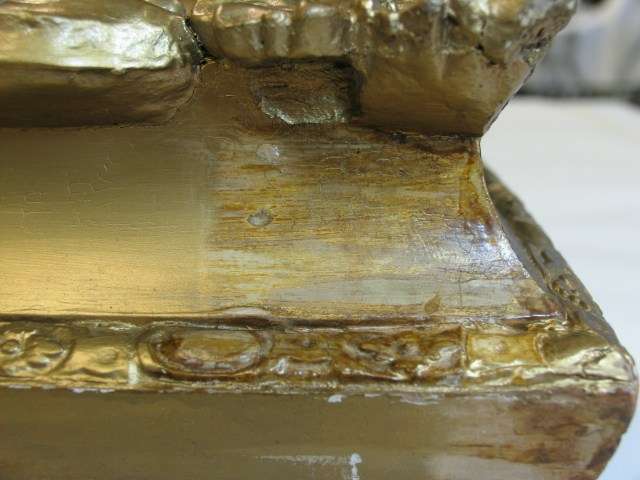
Close-up of the corner of the frame showing the difference between the left side, which is still covered in bronze paint, and the right which has been cleaned with acetone.
However, the fun is only beginning!
Underneath the bronze layer is a thick yellow layer of aged shellac (a natural resin varnish) and gesso, which has to be removed. Gesso consists of chalk and rabbit skin glue – sorry to all those vegetarians out there! The gesso is used to prepare the surface so it is smooth before applying the gold leaf . This is not the original gesso layer, it belongs to a later restoration. Buried under all this, is the beautiful original surface decorated with burnished (polished with an agate stone tool) and matt gilding.
The deteriorated shellac was softened with cotton wool and bandage compresses soaked in methylated spirits. The softened shellac was wiped away with cotton swabs dipped in the same solvent. The photo below shows how removal of the shellac has revealed much more of the frame’s original detail.
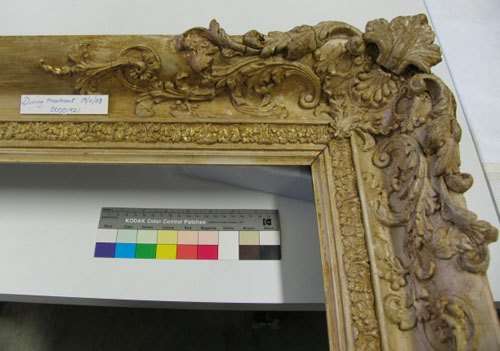
Detail of the frame after the removal of the shellac layer.
Once the shellac had been removed the next layer to tackle is the white gesso layer. This gesso layer belongs to a later gilding scheme. As there was practically no gilding left in this later scheme, I decided to take the frame back to it’s most original surface. Fortunately a lot of this original gilding is still intact, especially on the ornaments. The gesso is softened with water. I used a water based laponite gel to remove the gesso. Laponite is a synthetic inorganic colloid. It forms a thixotropic gel at aprox. 1gm/10ml. This was applied with a brush and after about 10 seconds the gesso along with the gel was scraped away with a wooden spatula. Very very satisfying!
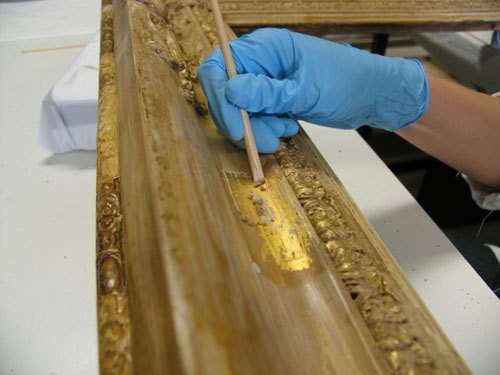
Area where gesso has been removed, revealing gold leaf.