
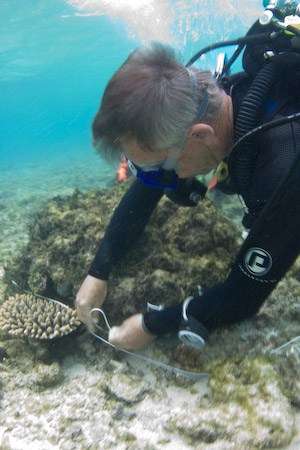
Dr. Nigel Erskine , ANMM, surveying a cluster of anchor chain on site.
I hope you have been following Alice and Megan’s blogs on the 2009 Mermaid Project over the last six days. Over the last couple of days the dive team have made a number of significant discoveries on Flora Reef. Two days ago during a magnetometer survey on the southern side of the reef the team picked up a small but impressive magnetometer signal about 150 meters offshore from what was then Flora Reef Unidentified shipwreck No 2. A team of divers were sent in and after only a short search located a 5 foot long, wrought iron kedge anchor sitting on top of a coral bommie in 7 meters of water. We know from historical accounts of the wreck that the crew of the Mermaid dropped a small kedge anchor about half a cable length from the stern of the vessel in an attempt to kedge (pull) the Mermaid off the reef. Their attempt failed and the kedge anchor and its coirfibre cable were abandoned.
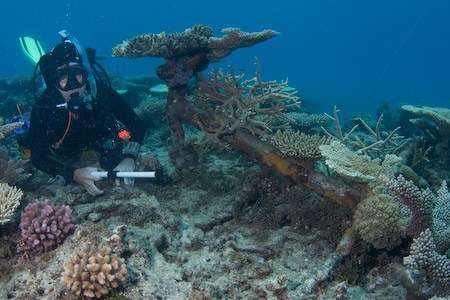
Lee Graham from the Museum’s Fleet section next to the Mermaid’s anchor.
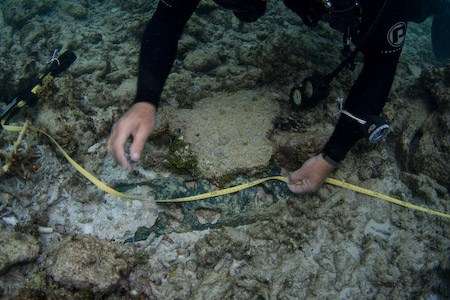
Paul Hundley, ANMM surveying in the schooner’s pump.
In itself the discovery of the anchor did not proove that that the wrecksite was HMCS Mermaid and the team continued to survey the site looking for additional information. Yesterday a metal detector survey uncovered a series of anomlies scattered amongst coral rubble on the southern side of the site. These anomlies have now been identified as being casement or cannister shot (packets of ball bearings contained within a small canvas bag of small wooden cannister) the team have also found fragments of copper sheathing, sheathing nails, ship’s fastenings, lead patches and several large magnetic anomalies on the wrecksite. This information along with the position of the wreck and the size of its remains has meant that we are now quite positive that the site is that of HMCS Mermaid wrecked off the Frankland Islands in 1829.
Archaeologists, scientific divers and volunteers divers and snorkellers are continuing their investigation of the site hoping to reveal more information about this fascinating vessel.
