
My name’s Dave Earl and, as reported in my last post, I’ve been busy researching the museum’s collection of naval small arms.One of the attractions of this project has been following the lives and careers of the seamen who owned used the objects I’ve been examining. Scattered amongst drier details of calibres, dates, and manufacturers are stories, details of past lives.
One interesting example is found in the service records of Lieutenant Commander Thomas Edward Mullins. Mullins served as a Sick Berth Steward on the HMAS Sydney (I) when it engaged with the German light cruiser SMS Emden in November 1914. During and after this battle, Australia’s first as a federated nation, Mullins “constantly attended [the] sick and wounded uninterruptedly for 6 days, including terribly severe cases which were received from SMS Emden.” As a result of his actions, Mullins was awarded the Distinguished Service Medal, one of only 17 issued to Australians during the First World War.
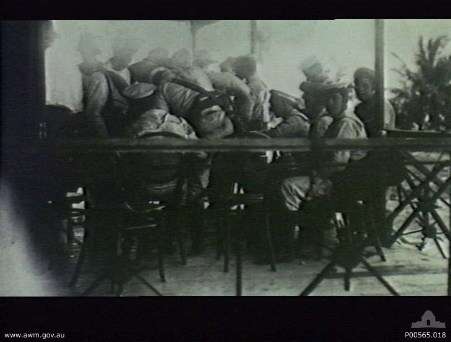
Crew From the HMAS Sydney celebrating on the Cocos Islands. Australian War Memorial P00565.018.
Eight years later, in July 1922, Mullins was promoted to the rank of Warrant Wardmaster. It is likely that a sword held by the museum, engraved with the text “THOMAS E MULLINS” and “PRESENTED BY S. B. STAFF / ROYAL AUSTRALIAN NAVY / 1922” commemorates his promotion. Eventually, in 1957, Mullins achieved the rank of Wardmaster Lieutenant Commander on the retired list.
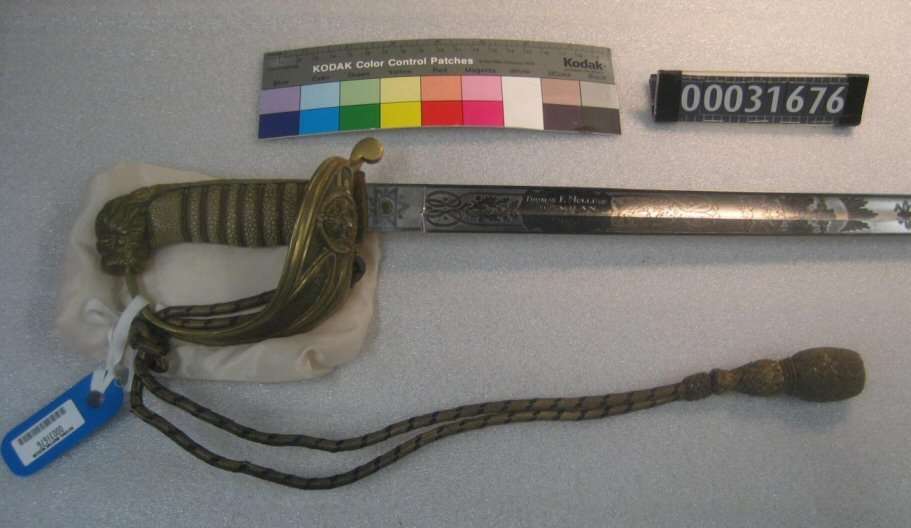
Naval officer’s sword presented to Thomas Mullins on his promotion in 1922. ANMM 00031676
Known to me as Lieutenant Commander Mullins D. S. M. through the museums records, I had imagined him as being a stately sort of naval gentleman. It was something of a surprise, when, browsing through his service records, I found that, when Mullins first enlisted in 1912 he was described as having “coiled snakes [tattooed] round neck—various figures and floral designs on arms R + L, butterfly on left leg, [butterfly on] each shoulder”
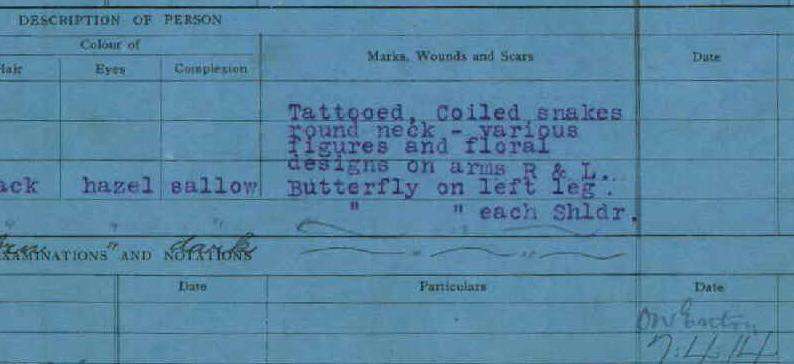
Thomas Edward Mullin’s tattoos, as described on his service record, held at the National Archives of Australia.
The service records of the sailors I have encountered reveal that many would have crossed paths during their duties. Mullins is one of several sidearm-owners who served on or were associated with the pride of the Victorian Colonial Navy, the HMVS (later HMAS) Cerberus. The Cerberus was launched in 1868 at the Chatham Dockyards in Kent before making an arduous journey to the Colony. She was the first entirely steam-powered ship in the British Navy, inspired by ironclad riverboats such as the USS Monitor, which had seen service in the American Civil War of 1861 – 65.
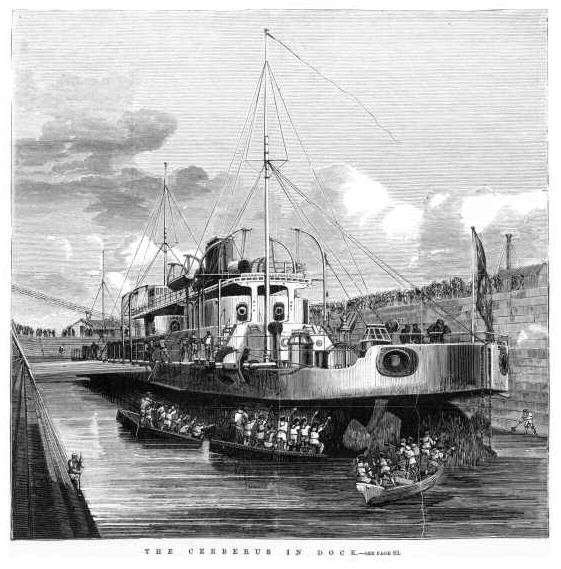
Wood engraving of the HMVS Cerberus in dock, 1874. From the State Library of Victoria, IAN18/05/74/73.
The Cerberus remained under Victorian control until 1901, when the Australian Commonwealth Government assumed control of defence, and she was absorbed into the Royal Australian Navy after its formation in 1911. By this stage she was dilapidated and out of date. Fifteen years later, having been sold as scrap to a private firm, she was scuttled in Half Moon Bay, Victoria, where she can still be seen. A group of enthusiasts, the Friends of the Cerberus, have campaigned for several years to have the ship preserved.
Next time you’re in the museum, be sure to take a look at the scale model of the Cerberus in the Navy Gallery.
A bayonet held by the museum is believed to have been used aboard the Cerberus by James Conder, a seaman who had a lengthy career on several significant Victorian and Australian vessels, including the HMAS Katoomba, HMAS Challenger, and HMAS Psyche. It is an unusual sword-style bayonet which would have fitted an 1855 model Lancaster (Sappers & Miners) Carbine, a rifle popular with the Volunteer and Rifle Club movement in the nineteenth. There is some evidence that Victorian volunteer defence forces were issued with these guns, and one firearms authority considers it likely that this (by then) obsolete small arm was carried on the Cerberus in the 1890s.
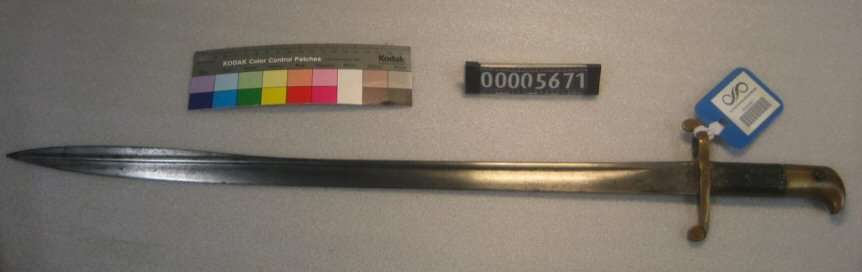
Bayonet for Lancaster (Sappers & Miners) Carbine, ANMM 00005671.
A final object with a Cerberus association is a double-barrelled flintlock pistol. It is yet another souvenir from the Boxer Uprising, this time believed to have collected by Walter Underwood. Described as a 5 foot 9 inch tall Protestant with black hair and hazel eyes, Underwood was a bandmaster with the Williamstown Division of the Victorian Naval Brigade. He served upon the Cerberus until his retirement in 1922. Underwood is pictured in a group portrait of the Victorian Navy Band photographed in 1898, holding his baton and leaning against the bass drum.
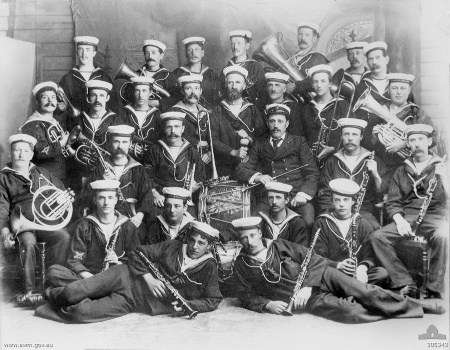
The HMVS Cerberus band in 1898. Underwood is moustached, leaning on the bass drum near the centre-right. Australian War Memorial 305343.
The pistol was produced by the firm Kynock & Co., which is known to have operated a plant in Warwickshire producing percussion sporting guns in the 1860s. This particular example is marked “Kynock & Co, Birmingham,” and stamped “TOWER 1867,” which roughly correlates with the estimated date of the pistol’s manufacture. It is further stamped “W U C E F 1901,” which I’m taking to stand for “Walter Underwood, China Expeditionary Force.” The question remains whether Underwood acquired the pistol from locals in China, or whether he obtained it from a British soldier, or perhaps even from the stores of the Naval Brigade, another antiquated relic like Conder’s bayonet. While in China, Underwood wrote letters home, and six of them are held by the Australian War Memorial in Canberra. Next time I head in that direction, I’ll be sure to stop by and take a look—they might shed some light on the mystery.
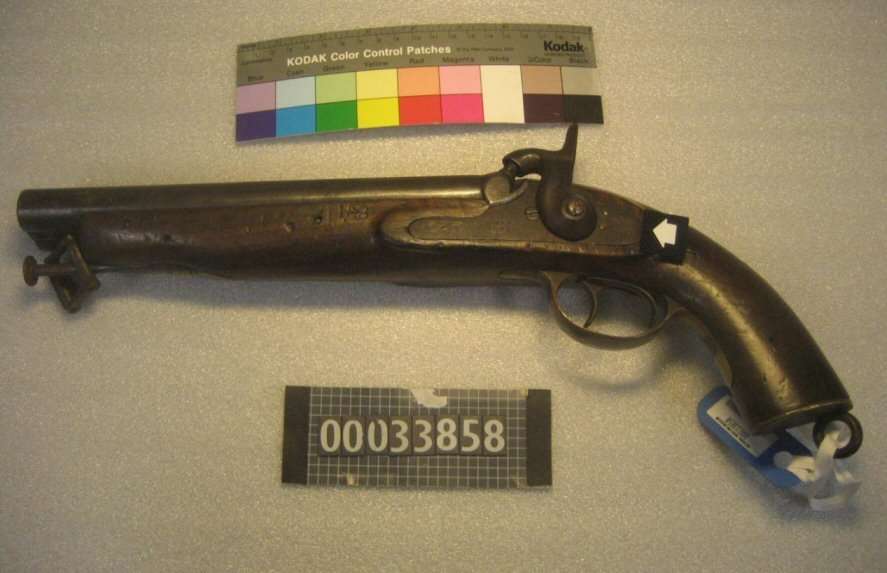
Double-barrelled flintlock pistol, marked “WUCEF”, ANMM 00033858.